How Does Nano Coating Work? Complete Guide with Science + Real Results
How Does Nano Coating Work? Complete Guide with Science + Real Results
Nano coating sticks to surfaces on a tiny level, building hidden protection through ultra-small connections. This method relies on SiO₂ bits - crazy small, like 80k times thinner than a strand of hair - to jam into minuscule gaps while locking in place chemically. Understanding how nano coating works helps explain why it’s so effective.
The Science: What Happens at the Molecular Level
Once you apply Nano coating, silicon dioxide doesn’t rest flat - it slips deep into tiny cracks and holes. Instead of sitting idle, it links up tightly with the surface atoms using strong chemical ties formed during cross-linking. This bonding action happens at a microscopic level, locking the layer firmly in place. Knowing how nano coating works at this level shows why it’s so durable.
A covalent bond ranks among the toughest chemical links found in nature. That’s how the layer doesn’t merely sit on top of your car’s paint or windshield - it merges right into the material itself. Because of this fusion, nanotech sealants keep going for years, unlike regular ones that fade within weeks.
The layer’s usually just 2 to 5 microns thick - about 0.002 to 0.005 mm. But even though it's super slim, it scores a solid 9H on the pencil test, close to what you’d see from sapphire glass.
The Application Process
The surface needs to be totally clear down to what you can’t see. Stuff like grease, grime, leftover wax, or rust film blocks a solid hold. Experts use most of their time - around 70 to 80 percent - just getting things ready since hidden junk still messes up the coat.
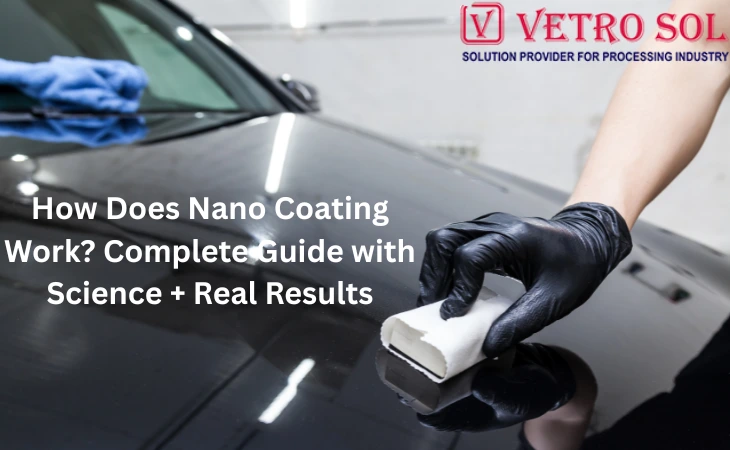
The liquid Nano layer goes on smoothly with special tools, one thin pass at a time. While it's wet, the solution holds the SiO2 bits floating evenly throughout. Just after 1–3 minutes, evaporation kicks in - so you wipe it gently to spread things out right.
Once applied, things really start changing. In the following day or two, SiO2 particles link up, forming strong ties with one another while attaching firmly to the material. That process builds a mesh-like framework across the area. Hardness hits roughly 70% after 24 hours, yet it keeps getting tougher over several weeks - slowly gaining peak durability and water-repelling strength.
Why Water Beads: The Hydrophobic Effect
One big sign of a Nano coating? How water acts when it hits the surface. Rather than flattening out, droplets bunch up into small balls and slide away fast. That’s down to what the coating does to how the surface interacts with liquids.
Each substance comes with its own surface energy, counted in dynes. Water’s surface energy sits around 72 dynes per cm. With Nano coatings, that number drops to between 15 and 25 dynes/cm. If water hits a surface weaker than its own, it pulls into round droplets to touch less.
This isn’t about looks. Because of the hydrophobic effect, water won’t stick around - instead, it beads up and slides away, so spotting doesn’t happen. As it moves off, it carries grime along with it. Thanks to this natural clean-up trick, you don’t have to wash nearly as often.
Protection Mechanisms: How It Defends Your Surface
The linked-up SiO2 setup is resistant to many chemicals. Bird droppings, which are full a of uric acid at pH 3–4.5, can quickly damage bare paint - sometimes in just hours. However, when there is a Nano layer, the acid stays on the surface, not penetrating the paint underneath. It's still best to wipe it off anyway; however, now you have days, not an urgent few hours, to do so.
Road salt, brake dust, tree sap, and bug substances splatter cannot penetrate the coating. These stay on the surface instead of sticking deep, so they can be rinsed away more quickly than if your car had no protection at all.
Sunlight’s UV rays can weaken paint by breaking its molecular bonds, leading to colour loss and aging. Instead of hitting the paint directly, those rays are absorbed or bounced off by the SiO2 shield. Over time, tests have shown that surfaces with this tiny coating suffer significantly less damage - about three-quarters less - from sun exposure than bare surfaces.
A Nano coating does not completely prevent scratches. Instead, it increases the surface's toughness - from 2H–4H, like regular paint, up to 9H. So small scrapes, such as those caused by dirt wiping past or fabric touching it lightly, will not leave marks. However, if an object is strong enough to chip glass, it will still damage the layer. The coating helps resist minor scratches, but it will not stop them completely. Still, it blocks around two-thirds of minor marks from everyday handling or cleaning.
Real Results: Measured Performance Data
Lab checks conducted by outside experts, using standard methods, prove that when nano ceramic layers are applied correctly, they remain water-repellent for anywhere from two to five years, depending on their location. If the weather is harsh, such as heavy sun or rain, the protective layer wears out faster than in areas with mild conditions.
A fresh Nano layer gives water droplets a tilt of 110-115°. After being left outside for twelve months, the but properly maintained, it retains its effectiveness - angit indicates les remain between 95 and 105°. Once readings drop below 90°, that the shield has worn out.
The paint's shine is checked in gloss units, abbreviated as GU, using a tool called a gloss meter. A fresh car’s finish typically ranges between 85 and 92 GU. After applying a nano coating, these numbers increase to about 95-98 GU. This boost occurs because the layer settles into tiny surface imperfections where light normally bounces off unevenly, resulting in a richer, smoother glow.
Why Some Coatings Fail
Bad preparation work causes most paint problems - about eight out of ten. Dirt or grease prevents the coat from sticking. Although it may seem fine at first, separation occurs quickly, sometimes in just a few weeks, since there was no real adhesion from the start.
Applying a heavy coat might sound right - yet it prevents the paint from hardening fully. The top layer dries the quickly, but underneath layer remains gooey, which causes problems later. Several light coats work much better than just one dense pass.
Rain, morning moisture, or rinsing within two days introduces water too early - before bonds fully form. It may look okay on the surface, yet end up less tough over time.
What Nano Coating Can that be to Do
Nano coating cannot fix damage already there. If scratches, swirl marks, water spots, or hazy areas were on the surface before, they will still show up afterward - no hiding them. Since the layer you add is clear, whatever is beneath remains fully in view.
It will not stop chunks of stone or heavy impacts. Since the layer is only 2 to 5 microns deep, a pebble flying at freeway speeds can easily punch through it along with the paint underneath.
It will not remove the necessity of washing. Dirt builds up less because of the self-washing feature - still, it sticks around. With the layer applied, scrubbing becomes simpler; yet, you will still have to do it.
Conclusion
Nano coating sticks by linking molecules together, forming a long-lasting shield that clearly improves scratch defense, guards against chemicals, blocks sunlight damage, while staying easy to clean. This isn't hype - it’s actual tech backed by solid research and proof from lab tests. Still, it needs careful use under stable settings, full prep work on surfaces, plus sensible assumptions about what it can do. You won’t turn your vehicle into an unbreakable object overnight; however, knowing how nano coating works shows why this method stands out as today’s top-tier, toughest shielding option around.