Nano Coating vs PPF: Which One Actually Protects Your Car Better?
Nano Coating vs PPF: Which One Actually Protects Your Car Better?
You've just bought your dream car. Or maybe you've had your beloved vehicle for a while now and you finally want to give it the protection it deserves. You've done some research and now you're stuck between two popular options - nano ceramic coating and PPF (Paint Protection Film).
You're not alone. This is one of the most common questions asked by car owners, detailing professionals, and businesses searching for the right ceramic nano coatings suppliers in India. Both solutions promise to protect your car's paint. Both come with their own advantages. But they work very differently - and choosing the wrong one could mean spending more money without getting the protection you actually need.
Let's break this down in a way that's easy to understand, so you can make a confident, informed decision.
What Is Nano Ceramic Coating?
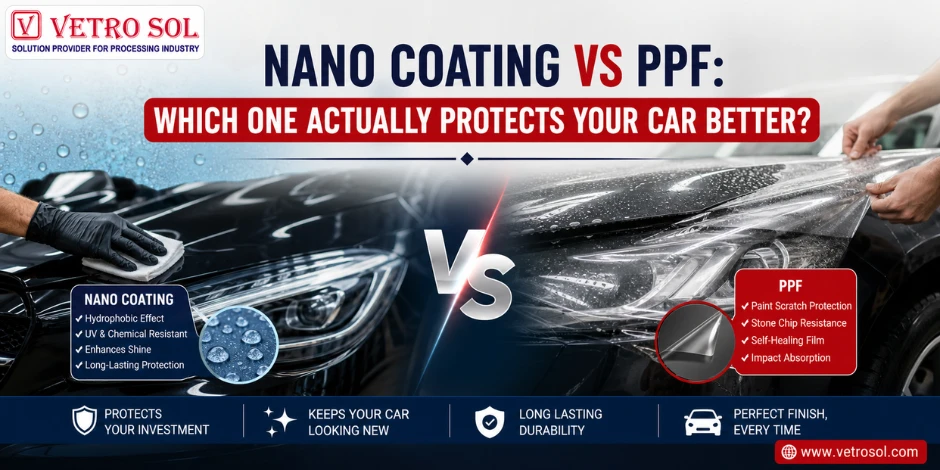
Nano ceramic coating - often called 9H nano ceramic car coating - is a liquid polymer that chemically bonds with your car's factory paint. Once applied and cured, it becomes a permanent or semi-permanent layer of protection that sits on top of your paint, acting like a second skin of liquid glass.
The "9H" refers to the hardness rating on the pencil hardness scale. At 9H, the coating offers excellent resistance against minor scratches, swirl marks, and surface contaminants.
How Does It Work?
At the molecular level, the silicon dioxide (SiO₂) particles in the coating fill the microscopic pores and imperfections in your car's paint surface. This creates a smooth, hydrophobic (water-repelling) surface where dirt, dust, water, and chemicals simply cannot stick.
Think of it this way - your car's paint surface is like a rough sponge under a microscope. The nano coating fills every gap and makes it as smooth as glass. Water and dirt just roll off.
Key Benefits of 9H Nano Ceramic Car Coating
- Creates an ultra-hydrophobic surface - water beads and rolls off instantly
- Enhances deep gloss and liquid-glass shine
- Protects against UV rays, oxidation, and paint fading
- Resists bird droppings, acid rain, tree sap, and industrial fallout
- Makes the car significantly easier to clean and maintain
- Thermal resistance up to 600°C
- Covalent bonding ensures long-lasting adhesion
What Is PPF (Paint Protection Film)?
PPF, or Paint Protection Film, is a thick, transparent thermoplastic urethane film that is physically applied over your car's paint surface. It acts as a physical shield - absorbing impacts, resisting scratches, and protecting against stone chips and road debris.
Unlike nano ceramic coating, which bonds chemically, PPF is a physical layer. Some premium PPF products even offer self-healing properties - minor scratches on the film disappear with heat exposure from the sun or warm water.
Key Benefits of PPF
- Offers strong physical protection against stone chips and deep scratches
- Self-healing technology available in premium grades
- Can be removed without damaging the original paint
- Provides a long lifespan of 5–10 years with proper care
- Ideal for high-impact areas like hoods, bumpers, and door edges
Nano Ceramic Coating vs PPF - Quick Comparison
Here's a side-by-side look at both solutions to help you evaluate which one suits your needs:
| Feature | 9H Nano Ceramic Coating | PPF (Paint Protection Film) |
| Protection Type | Chemical bonds to paint surface | Physical film over paint |
| Scratch Resistance | Moderate (9H hardness) | High (self-healing possible) |
| UV & Chemical Shield | Excellent – repels acids, bird droppings | Good – blocks UV but less chemical resistant |
| Hydrophobic Effect | Superb – extreme water beading | Moderate water repellency |
| Gloss & Shine | Deep, liquid-glass shine | Natural finish, less gloss |
| Thickness | Ultra-thin (few microns) | Thick film (6–8 mil) |
| Durability | 2–5 years with maintenance | 5–10 years depending on quality |
| Cost (India) | ₹8,000 – ₹25,000 | ₹20,000 – ₹80,000+ |
| DIY Friendly | Yes – kits available | Professional installation recommended |
| Removability | Not easily removable | Peelable without damage |
So Which One Is Better? Honestly, It Depends on Your Goal
Here's the truth - neither product is universally "better." They serve different purposes. Understanding your priorities will help you choose the right solution - or even combine both for maximum protection.
Choose 9H Nano Ceramic Car Coating If You Want:
- Brilliant gloss and showroom shine every single day
- Easy maintenance and effortless washing
- Protection against UV rays, chemicals, and environmental damage
- A cost-effective solution for full-body protection
- A product sourced from trusted ceramic nano coatings suppliers with OEM capability
Choose PPF If You Want:
- Maximum protection from physical impacts - stone chips, gravel, road debris
- Self-healing properties for scratch-prone areas
- A removable solution that won't permanently alter your paint
- Long-term coverage on high-risk panels like hood, bumpers, and mirrors
The Best of Both Worlds - Combine Them
Many professional detailers and car enthusiasts choose to apply PPF on high-impact zones (hood, front bumper, A-pillars, door edges) and then top the entire car - including the PPF - with a 9H nano ceramic car coating. This gives you the physical protection of PPF with the hydrophobic gloss and chemical resistance of nano ceramic coating.
It's the ultimate protection strategy - and one that's becoming increasingly popular among premium car owners in India.
Why the Right Supplier Makes All the Difference
Whether you choose nano ceramic coating, PPF, or both - the quality of the product you use matters enormously. A poor-quality coating that peels, yellows, or fails to bond correctly is worse than no protection at all.
When evaluating ceramic nano coatings suppliers, here's what to look for:
- OEM manufacturing capability - ensures consistency and quality control
- White label and private label options - flexibility for detailing businesses
- Proven formulation - look for covalent bonding technology and SiO₂ concentration
- Product testing and quality certifications
- Technical support and clear application guidelines
- Customized product development for specific market needs
A trusted supplier doesn't just sell you a bottle of coating. They give you the confidence that their product will bond properly, last long, and deliver on every promise - from hydrophobic performance to UV resistance.
Real-World Scenarios: Which Should You Pick?
Scenario 1: Daily Driver in a Dusty City
If you're driving through urban India - dealing with dust, pollution, bird droppings, and frequent washing - a high-quality 9H nano ceramic car coating is your best friend. It makes cleaning effortless, preserves the gloss, and protects against chemical contaminants that are everywhere in city environments.
Scenario 2: New Luxury or Sports Car
For a brand-new premium vehicle, combining PPF on vulnerable panels with a full-body ceramic coating on top gives you a fortress-level protection setup. The investment is higher, but so is the long-term value protection.
Scenario 3: Fleet or Commercial Vehicles
Businesses managing fleets of cars, trucks, or delivery vehicles will benefit most from working directly with ceramic nano coatings suppliers who offer bulk pricing, consistent product quality, and custom packaging. A nano ceramic coating across the fleet reduces long-term maintenance costs significantly.
Scenario 4: Car Detailing Business Owner
If you're running a detailing business, the right partnership with a ceramic nano coatings supplier who offers private label or white label products can help you build your own brand while delivering premium results to your customers. Look for suppliers who understand the professional detailing industry inside and out.
Nano ceramic coating and PPF are not rivals - they are complementary technologies designed to solve different problems. If your primary goal is gloss, easy maintenance, UV protection, and chemical resistance, a 9H nano ceramic car coating is the smarter, more cost-effective choice. If physical impact protection is your priority, PPF steps in where ceramic coatings have limitations.
For most car owners, a quality nano ceramic coating from a reliable supplier covers 90% of what you need - at a fraction of the cost of PPF. And when you source it from experienced ceramic nano coatings suppliers who specialize in professional-grade formulations, you can trust that the product will perform exactly as expected.
Your car deserves the best care. Make sure the coating you choose - and the supplier you trust - lives up to that standard.